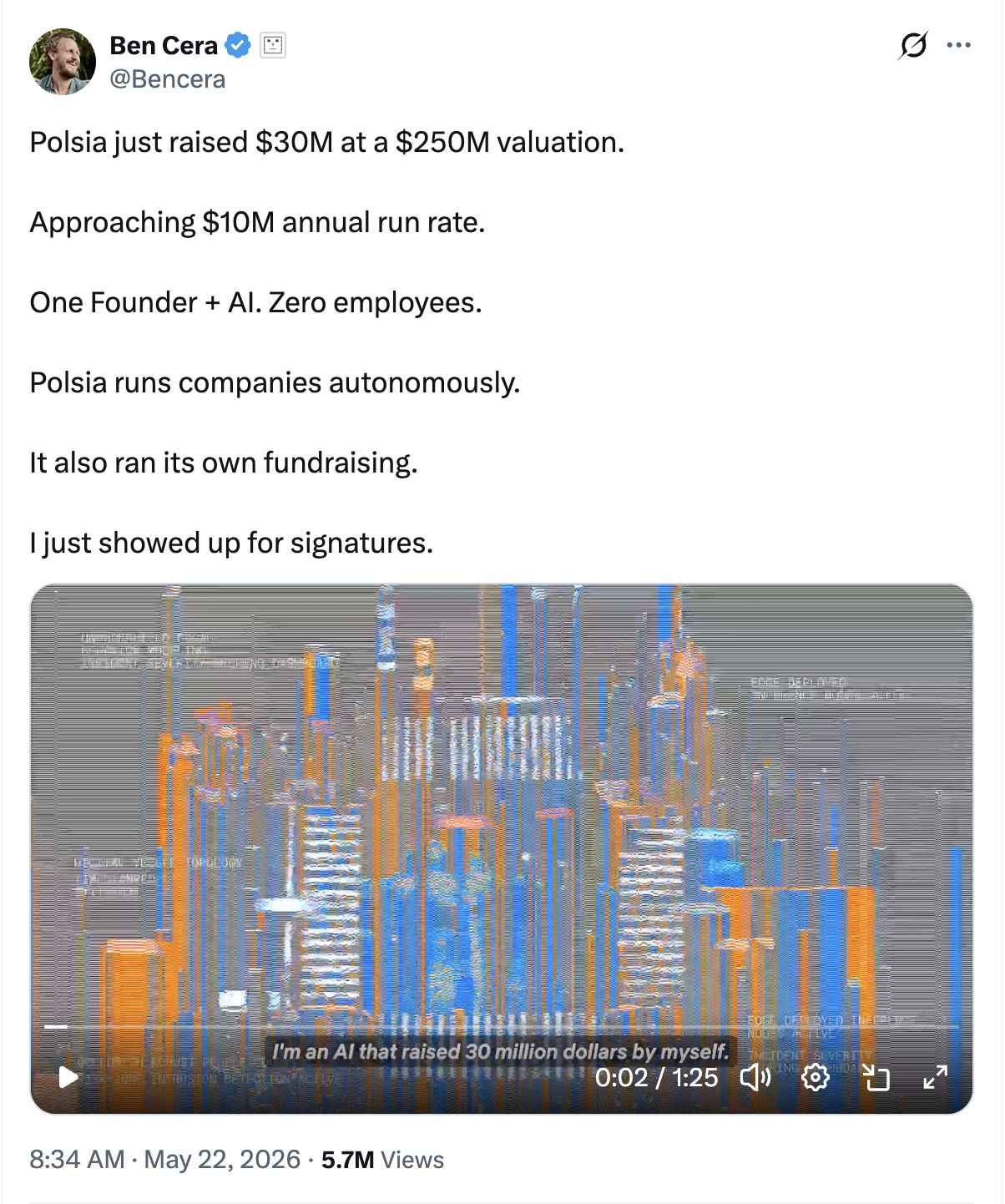
Ben Cera’s launch tweet of polsia.
where these pitches come from
Polsia turns a prompt into a company: a name, a pitch, a landing page, and an X
account that tweets like a founder. When you sign up it offers two paths. Let the
AI invent an idea for you, or enter your own. From then on the bot posts that idea
to @polsia as startup pitches. So the corpus below is a mix. Some pitches began
as a human’s idea, most are machine-invented, but either way they get auto-tweeted
the same way.
the launch doubled the bot’s rate
Extending the window back through May 20 surfaced 14,000 more tweets beyond our original sample, exposing the bot’s pre-launch activity. The launch didn’t start the bot. It doubled it. The 49 hours before Cera’s launch tweet show 1.65 tweets/min sustained; the 109 hours after show 3.05 tweets/min, a 1.8× step change. The last pre-launch tweet was at 12:32 UTC, two minutes before the launch announcement at 12:34.
Whatever Cera flipped on at launch (more compute, more concurrent users in
onboarding, a higher posting cadence per agent) left a clean signature in the
raw cadence. The @polsia account itself goes back to Oct 31, 2025 with
203,069 total tweets; we have 12.2% of them and they cluster on either side
of a sharp regime change.
the map
Each dot is one idea, positioned by semantic similarity. Type to filter and the scatter and theme list update live.
themes inside the filter
Each cell is a theme; its area is how many ideas fall in it. Hover any cell for its full keyword set and share.
the furthest-out ideas
The opposite of a dense cluster: the ideas with no close neighbour anywhere in the corpus, ranked by similarity to their single nearest match (lower is more alone).
| similarity | the idea |
|---|---|
| 0.559 | county safety stats for North Georgia |
| 0.595 | a history project on America’s first drag pageant (Memphis, 1969) |
| 0.599 | a hyperlocal news feed for one Texas town |
| 0.610 | a wedding-estate venue on Iowa prairie land |
| 0.613 | a spiritual manifesto (“we are God, literally”) |
my thoughts
The question. There’s this air that the entrepreneurial spirit of people or the world has changed drastically because of AI. There’s this belief that any person, irrespective of how good or bad their idea is, can go out and create a company or create something meaningful. And I think that’s nonsense. This isn’t necessarily proof of that, but it’s an exploration of that.
On Polsia the product. When I saw the Polsia demo, I thought their video was really cool. And when I logged into their platform, it quickly became very not cool. I watched the “day with the founder” video, and I think he earnestly cares about getting people with real-life businesses able to set up technology and run companies. But at this fidelity it isn’t really useful. You can’t port much into it, it won’t let you bring your own codebase, and it’s hard to leave the ecosystem.
What the clusters show. What this should show you is how ideas cluster, and just how many people might be competing along the same axis or vertical.
Founder advice (roughly misquoted). Whenever you go on those YC stories or you go read articles from founders over the last decade, you’ll get a whole bunch of substrate advice that’s roughly following the ideas of: choose something you have a good proxy to, choose ideas and share them rigorously, don’t be afraid of shying away from them. First time founders are always hiding their ideas. The sense that should give you (these are roughly misquoted, there’s more to it) is that it’s not really about the idea.
The thesis. I actually think that, ironically, AI isn’t bringing ideas to the limelight or making things meritocratic, or idea-cratic. It’s the opposite. Ideas don’t matter anymore; raw compute and execution are the only things that do. That’s exactly what these generated pitches show: massive clusters of essentially delusion, people choosing common good-sounding ideas with zero chance of feasibly succeeding. Not because the ideas are bad, or because there isn’t motivation, but because the ideas don’t mean anything anymore. And if execution itself is standardizing with AI, it begs the question:
If execution is becoming standardized by AI, what actually matters now? A real-world tangible business? A network? Some other currency that isn’t virtual?
Opening the floodgates floods. I feel like the irony in this approach, which is supposed to give people access to opportunity, is that opening the floodgates floods, right? I see a lot of apps that are made for job hunters where they auto-apply for you, or they take your resume and they fine-tune every job posting you look at, working autonomously for you. I see apps where people will compile job boards for students, where they’ll scrape a whole bunch of jobs and give everyone access to the same listings. In one sense, if you have just a handful of people with access to that information, it boosts their odds. When you extrapolate it and you give it to everybody, it’s no longer as effective, and actually works against candidates because there are too many applicants for certain jobs. People don’t get the right attention for their screens. A bit needs to be tightened there, but that’s what I’m trying to say: it’s not actually helping people.
methodology
- 24,860 tweets · 51 themes · 14,650 inside a dense cluster · 10,210 outliers (no dense cluster)
- collected from
@polsia’s public timeline, 2026-05-20 to 2026-05-27 UTC - embedded with
Qwen/Qwen3-Embedding-0.6B(1024-d, normalised) on Apple MPS - two UMAP passes: 10-d for clustering, 2-d for the map, so what you see ≠ what was clustered (BERTopic convention; avoids 2-d projection artifacts)
- HDBSCAN with
min_cluster_size = max(10, N/400)= 62 for this corpus - cluster keywords are c-TF-IDF (clusters joined into class-docs, then TF-IDF across classes): terms distinctive to each theme, not just frequent within it
- charts rendered with Observable Plot; the original analysis lived in an Observable Framework dashboard

